SKU vs UPC vs barcode: what is the difference?
A SKU is your own product code, a UPC is an official number, and a barcode is just a way to print either one. Here is which ones a small business really needs.
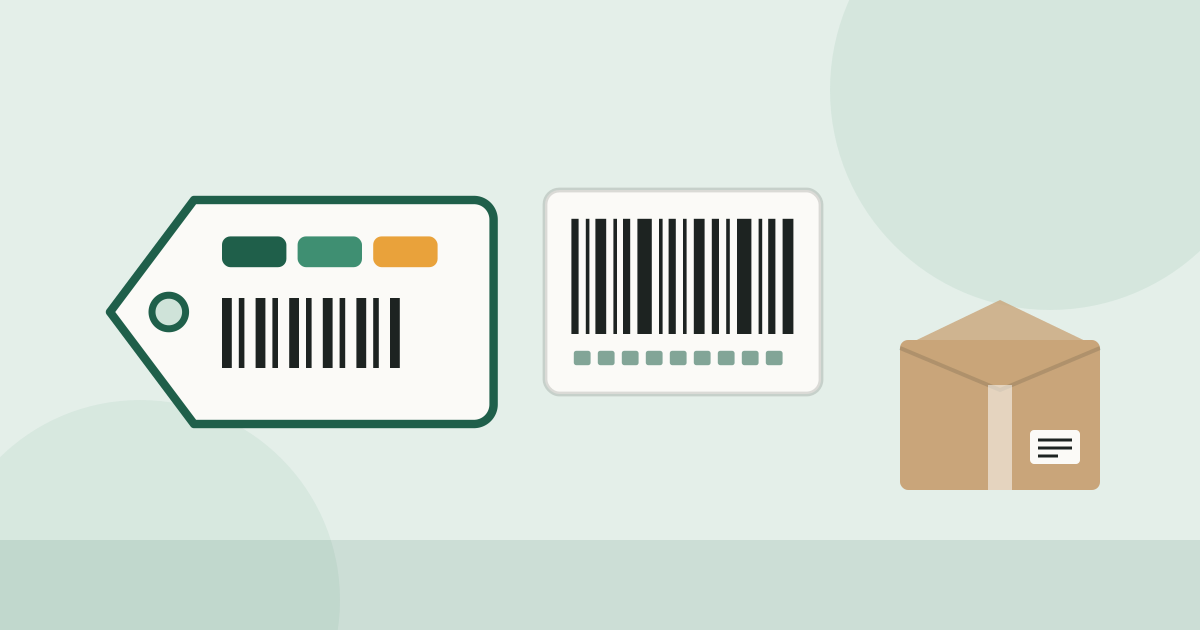
SKU, UPC, EAN, GTIN, barcode: these words are used as if they meant the same thing. They do not, and mixing them up leads to real problems, such as marketplace listings being rejected or stock records that no longer match.
The short version: a SKU is a code you invent, a UPC is a number you buy, and a barcode is a picture of either one.
The quick comparison
| SKU | UPC | Barcode | |
|---|---|---|---|
| What it is | Your internal product code | An official, globally unique product number | A machine-readable image of a number or code |
| Who creates it | You | GS1, the international standards body | Anyone, with free software |
| Format | Letters and numbers, any length | Exactly 12 digits | Lines or squares |
| Same across sellers? | No, each seller has their own | Yes, the same for everyone selling that product | Depends on what it encodes |
| Cost | Free | Paid licence | Free to generate |
| Main use | Managing your own stock | Selling through retailers and marketplaces | Scanning instead of typing |
What is a SKU?
SKU stands for stock keeping unit. It is a code you create to identify each product variant in your own business, for example MUG-BLU-L for a large blue mug.
- SKUs are not universal. Two shops selling the same mug will have two different SKUs.
- SKUs can contain letters, and usually should, because they make the code readable.
- You decide the format, and you can change it, though changing it later is painful.
A SKU is for you: your stock list, your picking, your reports. Our guide on how to create SKU numbers gives a format you can copy.
What is a UPC?
UPC stands for universal product code. It is a 12-digit number that identifies one specific product worldwide. The first part identifies the company that owns the brand, the next part identifies the product, and the last digit is a check digit.
- UPCs are issued through GS1, the organisation that manages product numbering. You pay for a licence.
- The UPC belongs to the brand owner. If you resell another brand’s product, it already has a UPC and you use that one.
- Every variant needs its own UPC: the large blue mug and the small blue mug are two numbers.
UPC, EAN and GTIN
- UPC has 12 digits and is the standard in the United States and Canada.
- EAN has 13 digits and is the standard in most other countries.
- GTIN (global trade item number) is the family name for both.
Modern scanners and marketplaces read all of them, so you do not need one of each.
What is a barcode?
A barcode is not a number. It is a way of printing a number or a code so a scanner can read it. The same barcode technology can carry a UPC, a SKU, a tracking number or a web address.
- The striped barcode on retail packaging is usually a UPC or EAN.
- A shipping label has several barcodes that carry tracking and routing data.
- A QR code is a two-dimensional barcode that can hold much more text.
This means you can print barcodes of your own SKUs for free and scan them in your stockroom, with no UPC involved. A common barcode format for this is Code 128, which supports letters and numbers.
Which ones do you need?
| Your situation | SKU | UPC or EAN | Barcode labels |
|---|---|---|---|
| You sell your own products on your own store | Yes | No | Optional |
| You sell your own products on large marketplaces | Yes | Usually yes, unless the marketplace grants an exemption | Often required |
| You sell your products to retail stores | Yes | Yes | Yes |
| You resell products from other brands | Yes | Use the brand’s existing one | Already on the product |
| You sell handmade or custom items | Yes | Usually no | Optional |
Every seller needs SKUs. You need UPCs only when someone else’s system has to recognise your product.
Where to get UPCs
Get them from GS1 in your country. Marketplaces increasingly check that a UPC is registered to the brand shown on the listing, and cheap numbers bought from resellers can be rejected because they are registered to another company. If you only need a handful, GS1 offers single numbers as well as company prefixes for larger ranges. Check your local GS1 office for current options and prices.
Common questions
Can I use the UPC as my SKU?
You can, but it is rarely a good idea. A 12-digit number is hard to read, and products without a UPC (bundles, samples, custom items) would be left without a SKU. Keep your own SKUs and store the UPC in a separate column.
Is an item number the same as a SKU?
In practice, yes. “Item number”, “product code” and “SKU” all describe a seller’s internal code. A marketplace may also assign its own identifier to a listing, which is a third number, separate from both your SKU and the UPC.
What about ISBN?
An ISBN is the official number for books. It plays the same role as a UPC, but for publishing.
Do I need a barcode scanner?
Not at the beginning. A scanner starts to pay off when you pick many orders a day or when counting stock takes hours. Many inventory apps can scan with a phone camera. See our stock count checklist for a way to count faster.
Key takeaways
- A SKU is your own internal code. A UPC is an official, paid number that is the same for every seller of that product.
- A barcode is only a printed, scannable version of a number. It can carry a SKU or a UPC.
- UPC (12 digits) and EAN (13 digits) are both types of GTIN.
- Every seller needs SKUs. UPCs are needed for retailers and most large marketplaces.
- Buy UPCs from GS1, and keep them in a separate column next to your SKUs.
Related guides
Best free inventory software for small business: 4 options that are really free
Free inventory software exists, with tight limits. Zoho Inventory, Sortly, a spreadsheet and your store's own stock tracking compared, with what each allows.

Economic order quantity (EOQ): formula, example and spreadsheet
The economic order quantity (EOQ) formula explained in simple words, with a worked example, an Excel and Google Sheets formula, and its limits.

FIFO vs LIFO: inventory methods explained with a simple example
FIFO vs LIFO vs weighted average explained with one worked example: how each method changes cost of goods sold, ending inventory and profit.